Marin: The Quiet Clue
Marin's careful drawings and quiet questions help her spot the small clue that a tangled dolphin needs.
LET’S LISTEN.
Press play to hear Marin: The Quiet Clue. You can pause whenever you like.
The recording could not load just now. Try opening the audio file, or read the full story below.
READ ALONG.
You can read at your own pace. All the words are here.
Everyone was watching the waves.
Everyone except Marin.
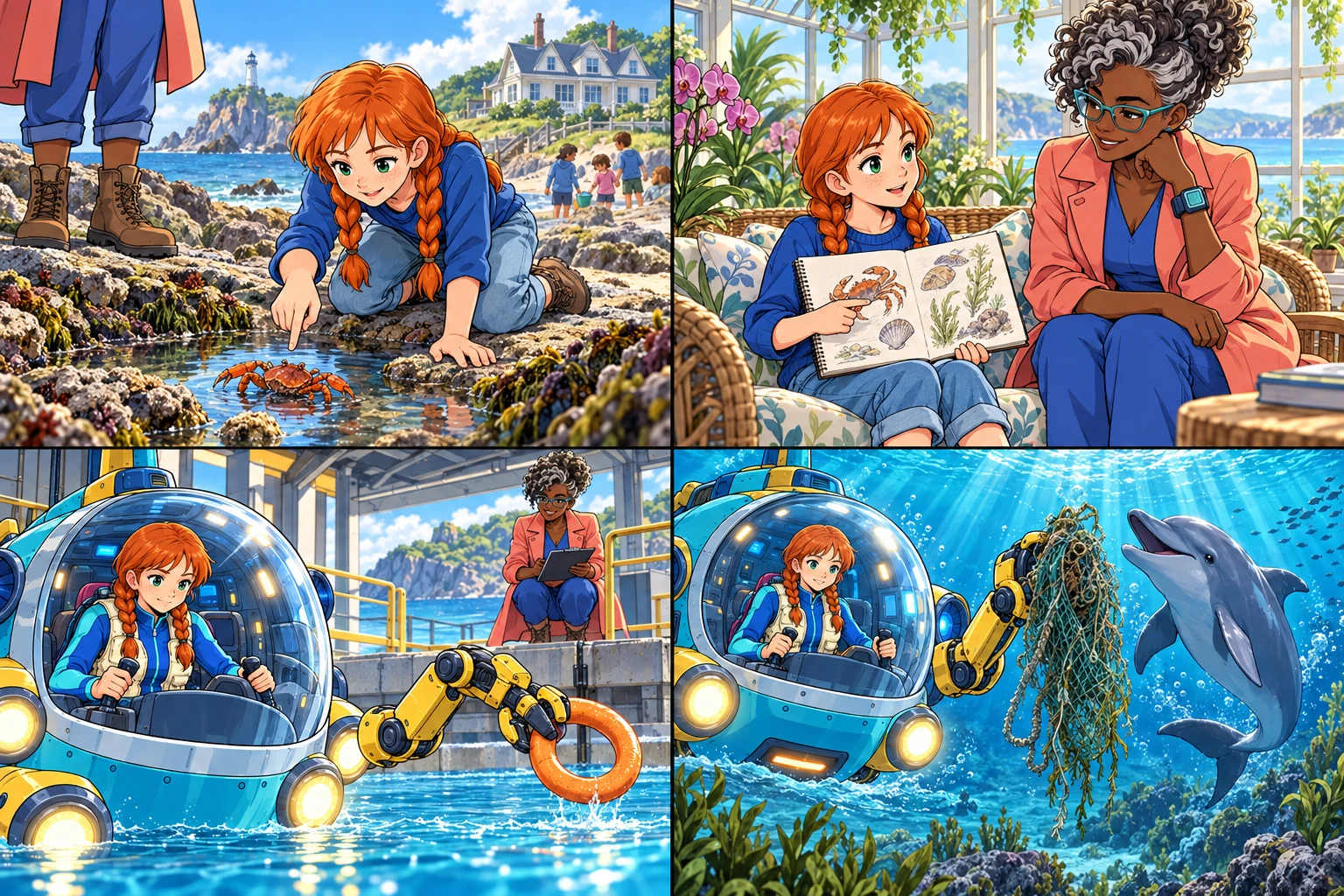
On a seaside walk near Harbour House, she had found a little pool between the rocks. A carer stayed nearby while she sat on a dry, safe spot with her sketchbook.
In the pool was a crab.
“Hello, little one.”
The crab moved sideways.
“Very stylish.”
Marin began to draw. She counted its legs carefully, including the two with claws. Ten altogether.
Her first drawing had twelve.
“That seems too many,” she told it. “You'd need a lot of shoes.”
The crab tucked itself behind a stone.
Marin waited. There it was again, peeping out.
She didn't pick it up. Watching was enough.
If you could give that tiny crab a name, what would you choose?
Marin simply wrote, “My very small neighbour,” beneath the picture.
After Felix and Vivienne adopted the five girls, Skylock House filled with voices.
Juno had ideas. Cleo had stories. Pip had questions about doors. Astra was trying to remember where everyone had left their slippers.
Marin loved them.
Sometimes she also wanted quiet.
Vivienne saved a place beside her in the conservatory, among the orchids.
Marin brought her sketchbook.
For a while, they sat without speaking.
Then Vivienne asked, “Tell me what you noticed.”
Marin showed her the crab.
She explained the pool, the stone, the sideways walk and the trouble with twelve legs.
Vivienne listened right to the end.
There was no hurry to become louder or different.
Next morning, when the kitchen conversation rushed past, Marin tried something new.
“I have a bit of the story too.”
Her sisters turned to listen.
As Marin grew, her sketchbooks filled with tide pools, sea plants and creatures with far more legs than seemed convenient.
Drawing helped her look carefully. To sketch something, she had to notice its shape, its movement and where it lived.
She learnt with marine experts, practised swimming and studied how trained teams helped animals without making a frightening situation worse.
She also learnt that dolphins breathe air.
“They live in the sea, but they're mammals,” she told Pip. “They come to the surface to breathe.”
“Like underwater neighbours who pop upstairs,” Pip said.
Marin considered this.
“Roughly.”
Her sister made a note.
Marin made a better drawing.
At home, she told terrible sea jokes.
“Why didn't the crab share its lunch?”
“No,” said Cleo.
“Because it was shellfish.”
Cleo groaned.
Marin looked delighted.
Ripple, Marin's submarine, was aqua and cobalt blue. Its clear bubble canopy gave her a wonderful view, and its yellow grab arms could move with great care.
But clever equipment still needed practice.
In the training pool, Marin tried picking up a soft ring.
Her first attempt pushed it away.
The ring drifted past the window like a tiny, rather smug moon.
Marin brought Ripple back and tried again.
Smaller movement. Better view. Gentle grip.
“Slowly. We've got time.”
She learnt to watch what the water was doing too. A current could move an object before the grab arm reached it.
With her instructors, she practised until each careful step felt familiar.
At the end, she lifted the ring neatly into its tray.
Juno applauded.
“Ten out of ten crab legs,” she said.
One day, a marine rescue team spotted a dolphin tangled in an abandoned fishing net.
It could still reach the surface to breathe, but it couldn't swim away.
Marin arrived in Ripple while the team kept watch above.
From one side, the net looked like a jumble of lines.
She felt the urge to do something at once.
Instead, she held Ripple steady and looked.
The dolphin moved. The net shifted. One loose edge lifted in the water.
There.
It reminded her of watching the crab emerge from behind its stone. A small change could reveal something hidden.
Marin spoke clearly over the radio.
“I can see a loose edge above its back.”
The team checked her view and agreed on a gentle plan.
She brought Ripple's grab arm towards the floating net.
Marin kept the grab arm clear of the dolphin itself.
Carefully, with the rescue team guiding her, she caught the loose edge and lifted the net away.
A moment later, the dolphin slipped free.
It rose for a breath, then swept through the open water.
Marin watched its shape grow smaller.
“Back to your big blue home.”
The team gathered the old net so it couldn't trap another animal.
That evening, Vivienne found Marin beside the orchids, drawing the rescue.
“Tell me what you noticed.”
Marin smiled.
“A loose edge. A small current. And one very good swimmer.”
She turned back to the sketchbook. Beside the new picture was her first crab drawing, its extra legs carefully rubbed out.
Little things, she thought, could tell a big story.
You just had to make room to see them.
Small details can make a big difference.
Something to explore: Careful observation, respecting sea life and sharing an idea clearly.
See Marin’s origin comicHAVE A LITTLE CHAT.
- How did drawing help Marin notice details?
- Why did the dolphin need to reach the surface?
- What helped Marin feel ready to share her quiet ideas?
ANOTHER BEGINNING?
 06
06Pip: The Map Between Us
Pip's first map joins five friends together. Years later, a fallen tree helps her discover why a good navigator listens as well as looks.
 01
01A Place for Five
Before the rescue machines, five girls find one another at Harbour House, then discover that a new family has room for every feeling.