Pip: The Map Between Us
Pip's first map joins five friends together. Years later, a fallen tree helps her discover why a good navigator listens as well as looks.
LET’S LISTEN.
Press play to hear Pip: The Map Between Us. You can pause whenever you like.
The recording could not load just now. Try opening the audio file, or read the full story below.
READ ALONG.
You can read at your own pace. All the words are here.
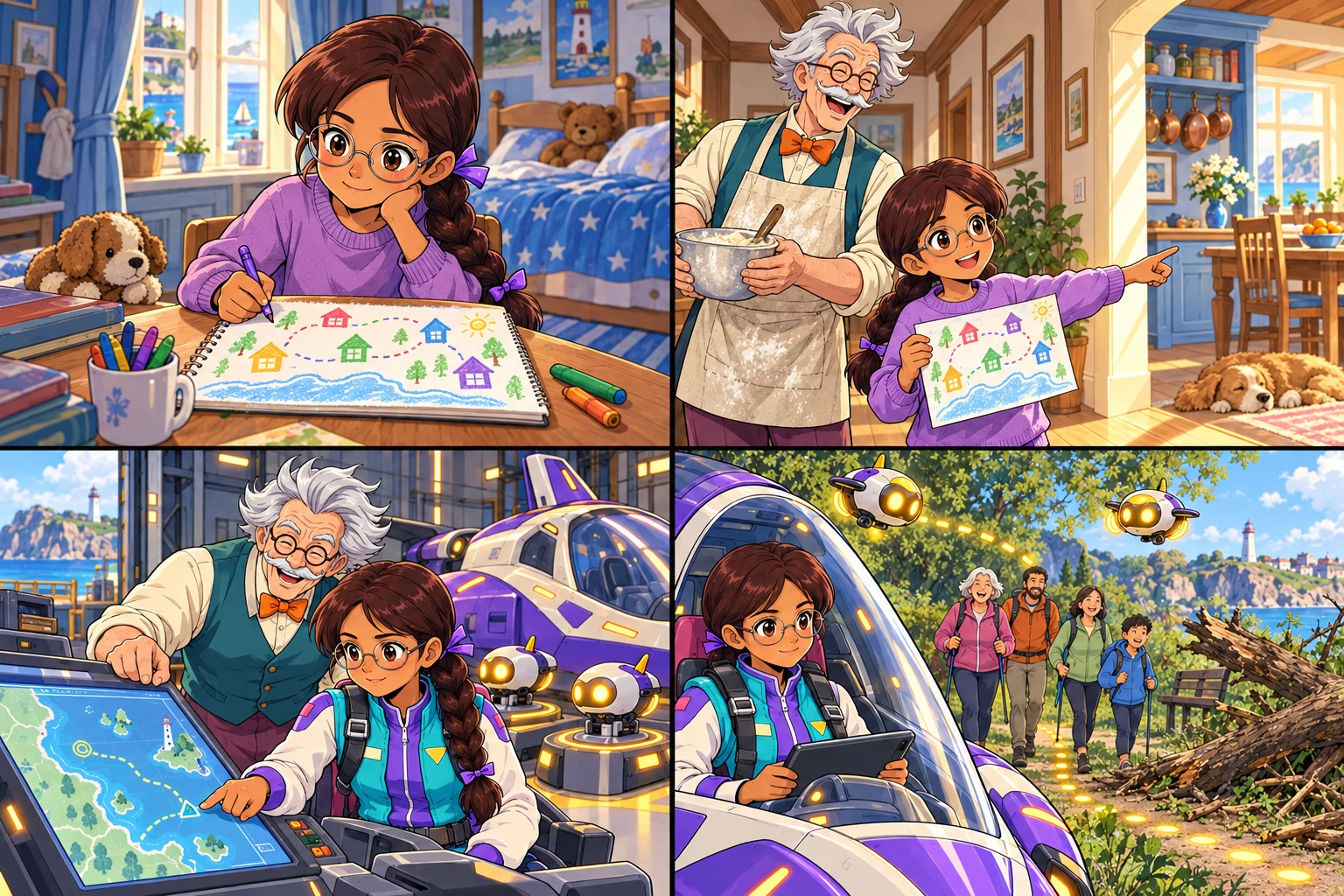
Pip drew five houses.
One had a tall chimney. One had a striped door. One had a sign that said, “Hats welcome.”
They weren't really houses.
They were beds.
At Harbour House, Pip sometimes felt far from everyone, even when her friends were nearby. So she drew them a map.
“This is Astra. This is Cleo. Juno lives here. Marin is beside the sea.”
“That's a drinking glass,” Juno said.
“A very small sea.”
Pip joined the houses with paths. Now a friend was always easy to find.
In one corner, she drew a tiny dragon.
“Does it live here too?” Cleo asked.
“Only on paper. It isn't allowed to eat the furniture.”
Cleo nodded. A sensible rule.
Pip showed the others how the paths worked.
“No one gets lost,” she said.
When the girls joined Felix and Vivienne's family, Skylock House seemed full of doors.
Some led to bedrooms. Some led to cupboards. One led to a room with so many plants that Pip suspected a small jungle.
On her first morning, she found Felix looking down a corridor.
“I'm taking a scenic route to breakfast,” he explained.
“Are you lost?”
“Only slightly.”
Pip fetched paper.
She drew their rooms, the stairs and the kitchen. Then she added a mug beside the kitchen door.
“A picture can stand for a place,” she told him.
Felix studied the map.
“And this dragon?”
“Not a real place.”
“Good. It looks hungry.”
Soon they found the kitchen.
Vivienne had saved their toast.
“Kitchen this way!” Pip announced, a little late.
Felix applauded anyway.
Breakfast deserved a proper arrival.
Felix helped Pip learn more about maps as she grew.
A map couldn't show every leaf or every biscuit crumb. It chose useful things.
A bridge. A gate. A building. A path.
Symbols stood for places, and a key explained the symbols.
Pip made a treasure trail for her sisters, with biscuits at the end.
Unfortunately, her first key used the same little square for a bench and a shed.
Juno sat beside the shed for several minutes, waiting for a clue to appear.
Pip changed the symbols and tried again.
Think of a familiar place. What picture could stand for it on a map?
Pip chose a star for the finish.
She kept the dragon in the corner.
Then she checked that everyone understood the route before the biscuits mysteriously vanished.
Felix denied everything.
Years of learning brought bigger maps, proper navigation lessons and lots of practice.
Pip learnt to guide the Firefly rescue pod and its small helper drones, the Fireflies.
They could search, send back pictures and shine lights along a checked route.
They could not decide everything for her.
She had to think.
She also had to listen.
During one practice, Pip chose the shortest path to a marked landing spot.
Astra pointed to the map.
“What's between those two trees?”
“A low branch.”
“Will the pod fit?”
Pip looked again.
“No.”
They chose a wider way round.
Being quick with a map was useful. Checking what the map meant in the real world was better.
Pip wrote a reminder in her sticker notebook.
“Let’s check the route first.”
The dragon beside it looked approving.
One evening, families were leaving a picnic in the park when a fallen tree blocked the main path.
The wind had dropped, and the park keepers were checking the grounds. Nobody was hurt, but everyone needed another way to the gate.
Pip arrived in Firefly and parked safely beside the keepers.
She studied the map on her screen.
“There’s another way round!”
A narrow path crossed a little bridge.
A keeper leaned closer.
“That bridge has steps. We've got a pushchair here, and someone using a walking frame.”
Pip stopped.
Her first route would not work for everyone.
She asked the keeper about the wider paths.
Together they found a level route past the pond, well away from the fallen tree.
The keepers checked it on the ground.
Now Pip had a better plan.
As daylight faded, the Fireflies rose from their carrier.
Pip guided them from the parked pod. Their little lights marked the safe route, while the keepers walked with the families.
Past the pond. Beside the flower beds. Through the wide gate.
“This way, everyone!”
A child waved at one of the drones.
“Is it a fairy?”
“A helper machine,” Pip called. “Very good at glowing. Terrible at eating biscuits.”
At last, everybody reached the gate.
The keeper thanked her.
“You helped me too,” Pip said. “You knew about the steps.”
Back home, she opened her oldest notebook.
Five little houses. Five winding paths.
Her first map had helped friends find one another.
Her new map had helped a whole crowd.
Different paths. Same idea.
Make sure there's a way for everyone.
In the corner, the little dragon kept watch.
There's more than one way to help.
Something to explore: Map symbols, landmarks and choosing a route that works for everyone.
See Pip’s origin comicHAVE A LITTLE CHAT.
- Why does a map need a key?
- Why wasn't the shortest park route the best route?
- What could you ask to check that a plan works for everyone?
ANOTHER BEGINNING?
 01
01A Place for Five
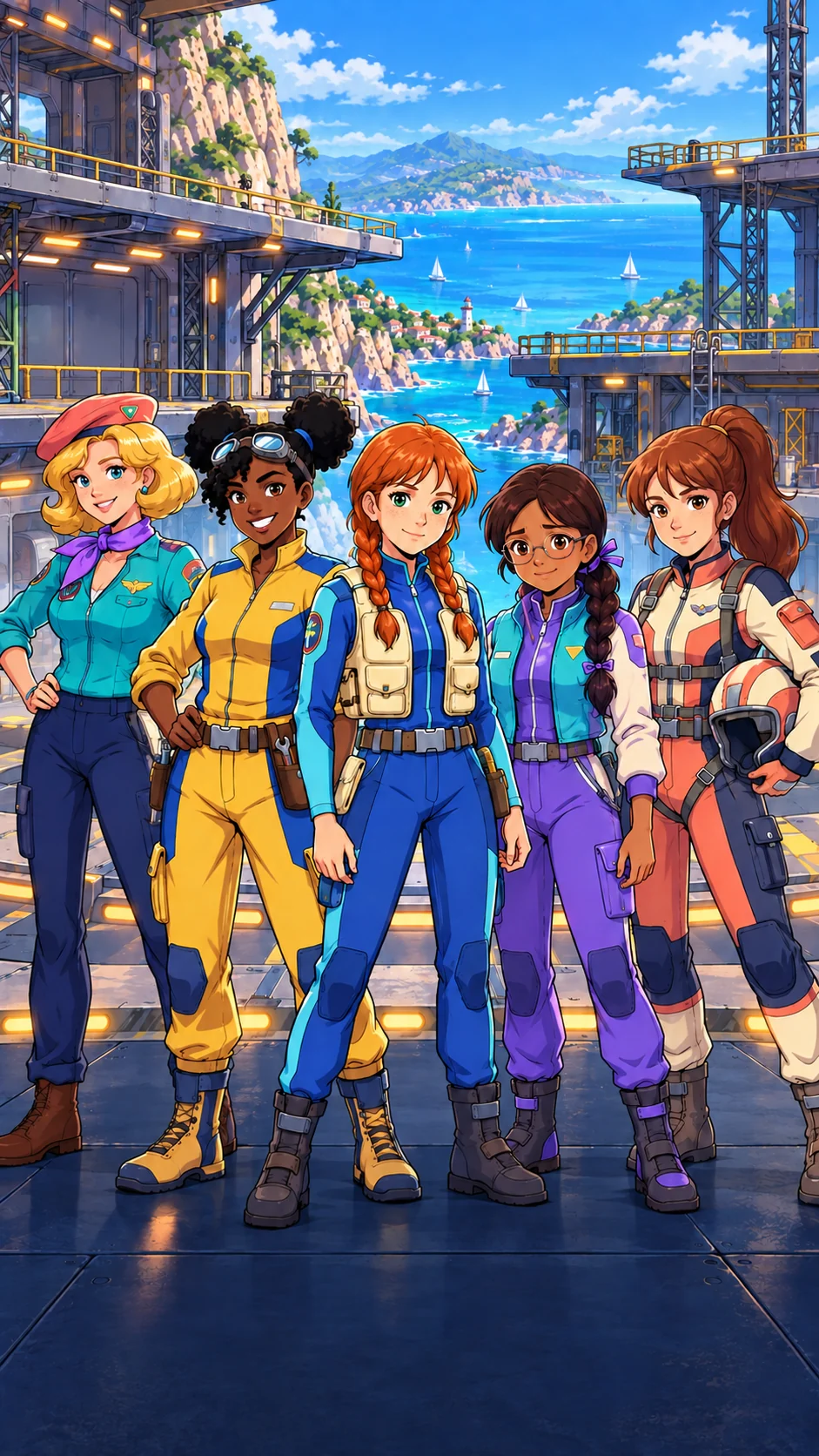
Before the rescue machines, five girls find one another at Harbour House, then discover that a new family has room for every feeling.
 02
02Astra: A Little Lift
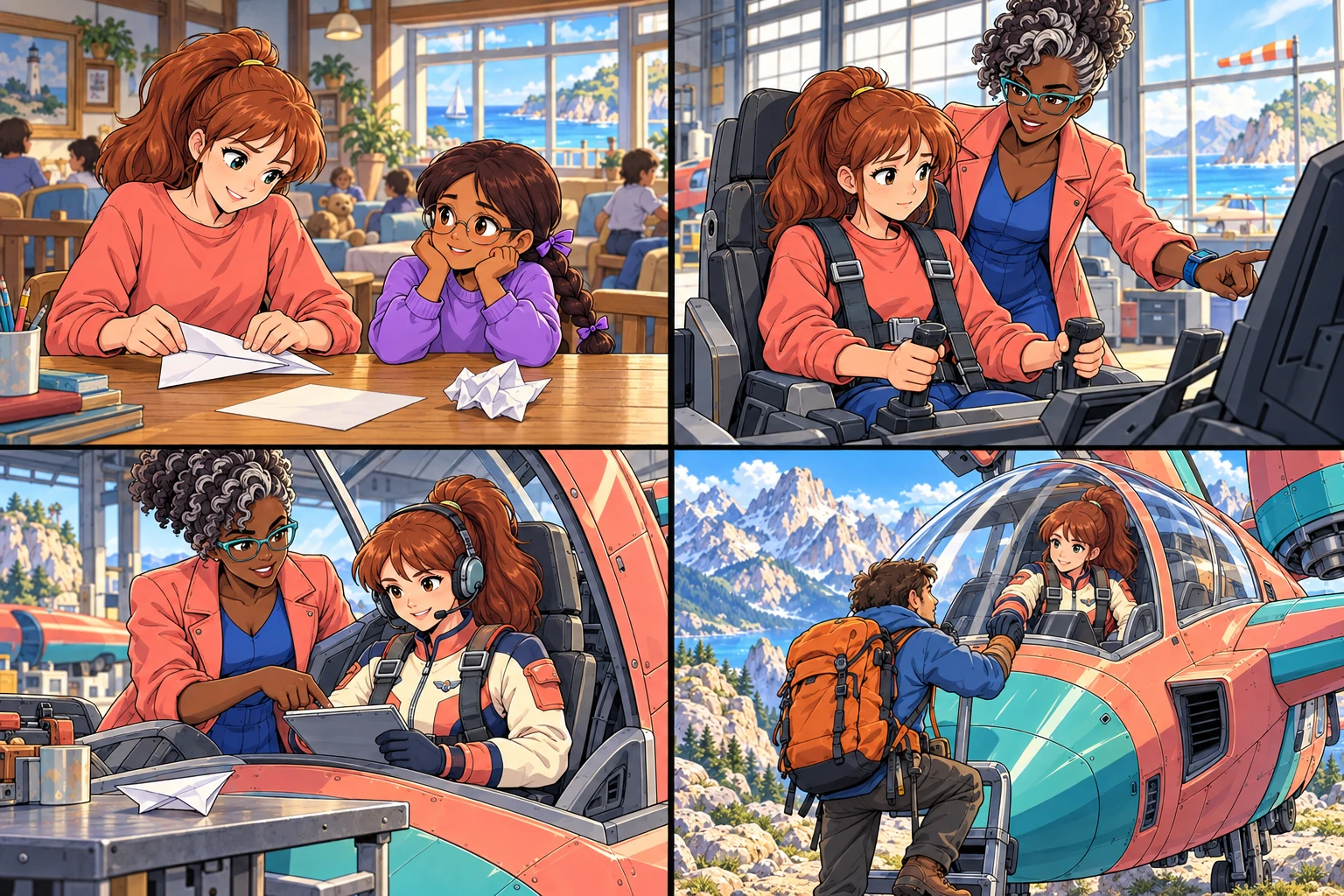
A paper plane that refuses to fly helps Astra learn the question she will need on her first mountain rescue.